
Blockchain Explained: How It Works Without the Jargon
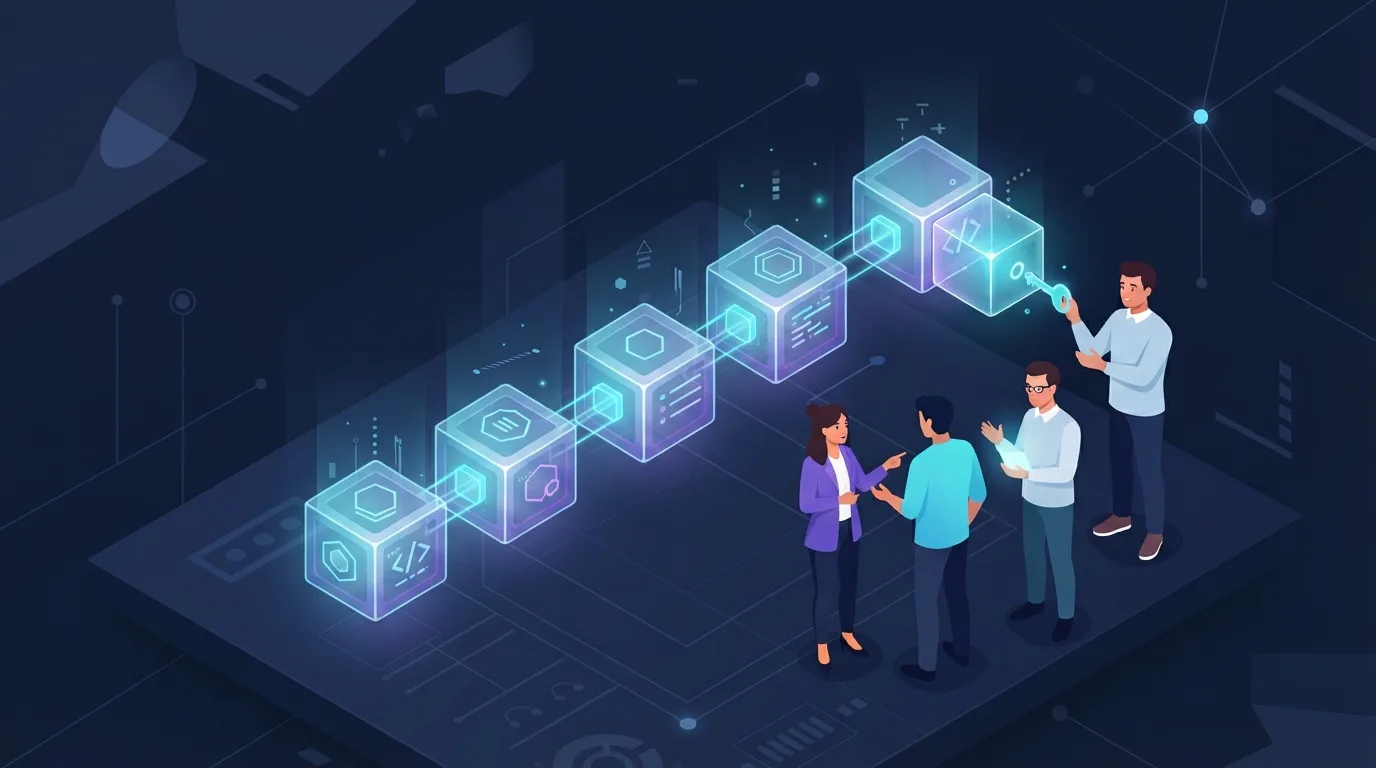
A plain-English guide to blockchain: what it is, how it works, why it matters, and where it is used today. No jargon, just clear analogies and real examples.
Imagine a shared notebook that no single person owns, where every entry is permanent and visible to everyone. That is the simplest way to understand blockchain: a distributed ledger, or a record book, that many computers keep in sync. This guide explains how blockchain works in plain English, without the technical jargon. We will cover what a blockchain is, why it matters, how it works step by step, real-world use cases, risks, and how to get started.
What is a blockchain?
A blockchain is a digital record of transactions, duplicated across many computers and secured by cryptography. Instead of one central database, the record is shared. Each new batch of transactions is grouped into a "block" and linked to the previous block, forming a chain. Once a block is added, changing it would require altering every later block on most computers in the network, which is impractical.
The shared notebook analogy
Think of a village where everyone keeps the same ledger of who owns what. If someone tries to secretly change their own copy, the other villagers compare notes and reject the fake entry. In blockchain, those villagers are computers called nodes, and the comparison rule is called consensus.
Key properties
- Decentralised: no single point of control.
- Immutable: past records are extremely hard to change.
- Transparent: depending on the network, anyone can inspect the ledger.
- Programmable: some blockchains run code called smart contracts.
Concrete example
Bitcoin, launched in 2009, is the first widely used blockchain. Its ledger records ownership of bitcoin (BTC). Anyone can view the list of transactions on a block explorer, even though the identities behind the addresses are pseudonymous.
Why blockchain matters
Blockchain matters because it reduces the need to trust a single middleman. In traditional systems, a bank, a notary, or a platform keeps the official record. If that record is wrong, lost, or censored, users have limited recourse. A distributed ledger offers an alternative: many independent parties maintain the same record and agree on its state.
Concrete example
Cross-border payments often pass through several banks, each taking a fee and adding delay. A blockchain-based transfer can settle directly between parties in minutes, as seen with networks like Stellar or Ripple. The trade-off is that the user must manage keys and accept new risks.
Caption: On the left, one central database controls the record. On the right, many nodes hold identical copies and agree on updates.
How blockchain works, step by step
Step 1: A transaction is created
A user signs a transaction with a private key. The signature proves authorisation without revealing the key itself.
Transaction = { from: address_A, to: address_B, amount: 1.5, fee: 0.0002, signature: ... }
Step 2: The transaction is broadcast
The transaction is sent to the network of nodes. Each node checks basic rules: does the sender have enough funds? Is the signature valid?
Step 3: Transactions are grouped into a block
Valid transactions wait in a pool. A block producer (a miner or validator) selects some of them and forms a block.
Step 4: Consensus is reached
Nodes agree on the next block using a consensus mechanism. The two best-known are Proof of Work (PoW) and Proof of Stake (PoS).
| Mechanism | How it works | Example | Trade-off |
|---|---|---|---|
| Proof of Work | Miners compete to solve a puzzle | Bitcoin | High energy use |
| Proof of Stake | Validators lock coins as collateral | Ethereum (since 2022) | Wealth concentration risk |
Step 5: The block is added and linked
The new block contains a reference (hash) to the previous block. Changing an old block would break every later hash, alerting the network.
Concrete example
On Ethereum, a simple transfer costs a fee called gas. In 2021, during peak demand, gas fees sometimes exceeded USD 50 per transaction (to verify). Upgrades like EIP-1559 and layer-2 networks such as Arbitrum and Optimism have since reduced typical costs, though they vary with network activity.
Real-world use cases
Cryptocurrencies
Bitcoin and Ether are the most visible use cases. They allow peer-to-peer value transfer without a bank.
Supply chain tracking
Companies like IBM Food Trust and VeChain record product journeys on a blockchain, so a retailer can verify where a lettuce head came from.
Digital identity
Projects such as Microsoft ION (built on Bitcoin) explore decentralised identifiers, letting users control their own login credentials.
Smart contracts and DeFi
Ethereum introduced programmable money. Decentralised finance (DeFi) protocols like Uniswap and Aave run on smart contracts, offering lending and trading without a traditional intermediary.
NFTs and provenance
Non-fungible tokens (NFTs) record ownership of digital art or collectibles. The blockchain proves provenance, not the artistic value.
Concrete example
In 2021, a digital artwork by Beeple sold as an NFT for USD 69 million at Christie's (to verify). The sale demonstrated how a blockchain can certify ownership of a digital file, even if the file itself can be copied.
Risks, limits and misconceptions
Not everything needs a blockchain
A blockchain is useful when multiple parties need a shared record without a trusted central party. For a single company's internal database, a normal server is faster and cheaper.
Irreversibility cuts both ways
If you send crypto to the wrong address, there is usually no undo button. This is a feature for censorship resistance, but a risk for users.
Energy and scalability
Proof of Work consumes significant electricity. Proof of Stake reduces it dramatically, but scalability remains a challenge: Bitcoin processes about 7 transactions per second, Ethereum around 15 (to verify), far below Visa's thousands.
Common misconceptions
- "Blockchain is anonymous." It is pseudonymous; transactions are traceable.
- "Blockchain equals Bitcoin." Bitcoin is one blockchain among thousands.
- "Smart contracts are legally smart." They execute code; legality depends on jurisdiction.
Concrete example
In 2016, The DAO, a venture fund on Ethereum, was drained of about USD 50 million due to a code flaw. The community chose to reverse the theft via a hard fork, splitting Ethereum and Ethereum Classic. It showed that "immutable" can be nuanced when humans coordinate.
How to get started
A beginner checklist
- [ ] Learn the basics: read one article and watch one explainer video.
- [ ] Create a wallet: use a reputable software wallet for small amounts.
- [ ] Secure your seed phrase: write it on paper, store it offline, never share it.
- [ ] Start small: send a tiny test transaction first.
- [ ] Verify addresses: double-check the first and last characters.
- [ ] Explore a block explorer: paste a transaction ID and see the details.
- [ ] Stay sceptical: ignore promises of guaranteed returns.
Concrete example
A common first step is setting up MetaMask, adding a small amount of Ether, and swapping a few dollars on a decentralised exchange. The goal is to experience the mechanics, not to invest.
Conclusion: blockchain explained without the hype
Blockchain is a shared, tamper-resistant record kept by many computers. It removes the need for a central gatekeeper in specific situations, but it is not a magic fix for every problem. Understanding the trade-offs, from energy use to irreversibility, is part of being an informed user. Use this guide as a map, not a promise.
FAQ
Is blockchain the same as Bitcoin?
No. Bitcoin is the first major application of blockchain technology. Many other blockchains exist, each with different rules and goals.
Can I use blockchain without buying cryptocurrency?
Yes. You can interact with blockchains for supply chain tracking, identity, or voting without holding a tradable coin, though many public networks require a small fee in their native token.
Is blockchain private?
Public blockchains are transparent by default. Privacy-focused blockchains and techniques like zero-knowledge proofs exist, but they add complexity.
What is a distributed ledger?
A distributed ledger is any record kept in sync across multiple locations. A blockchain is a type of distributed ledger that links records in blocks.
Do I need to understand code to use blockchain?
No. Wallets and apps hide the code. But understanding basic concepts helps you avoid mistakes and scams.
Disclaimer: This article is for educational purposes only and does not constitute financial advice. Always do your own research.
Comments (0)