
Decentralization Blockchain: The Core Idea Behind Web3

Decentralization is the engine behind blockchain and Web3. This guide explains what it really means, why it matters, how it works, and where it falls short — with concrete examples.
Decentralization blockchain means moving control of a system away from a single authority and spreading it across many independent participants. In practice, no single company, server or administrator can rewrite the rules or the records alone. That single idea explains most of what makes blockchain and Web3 different from the internet we use every day.
If you have ever wondered why people get so excited about "trustless" systems, or why a crypto network can keep running when its founder disappears, the answer almost always comes back to decentralization. This guide unpacks it in plain language: what it is, why it matters, how it works step by step, where it is used, and where it falls short.
What Is Decentralization, Really?
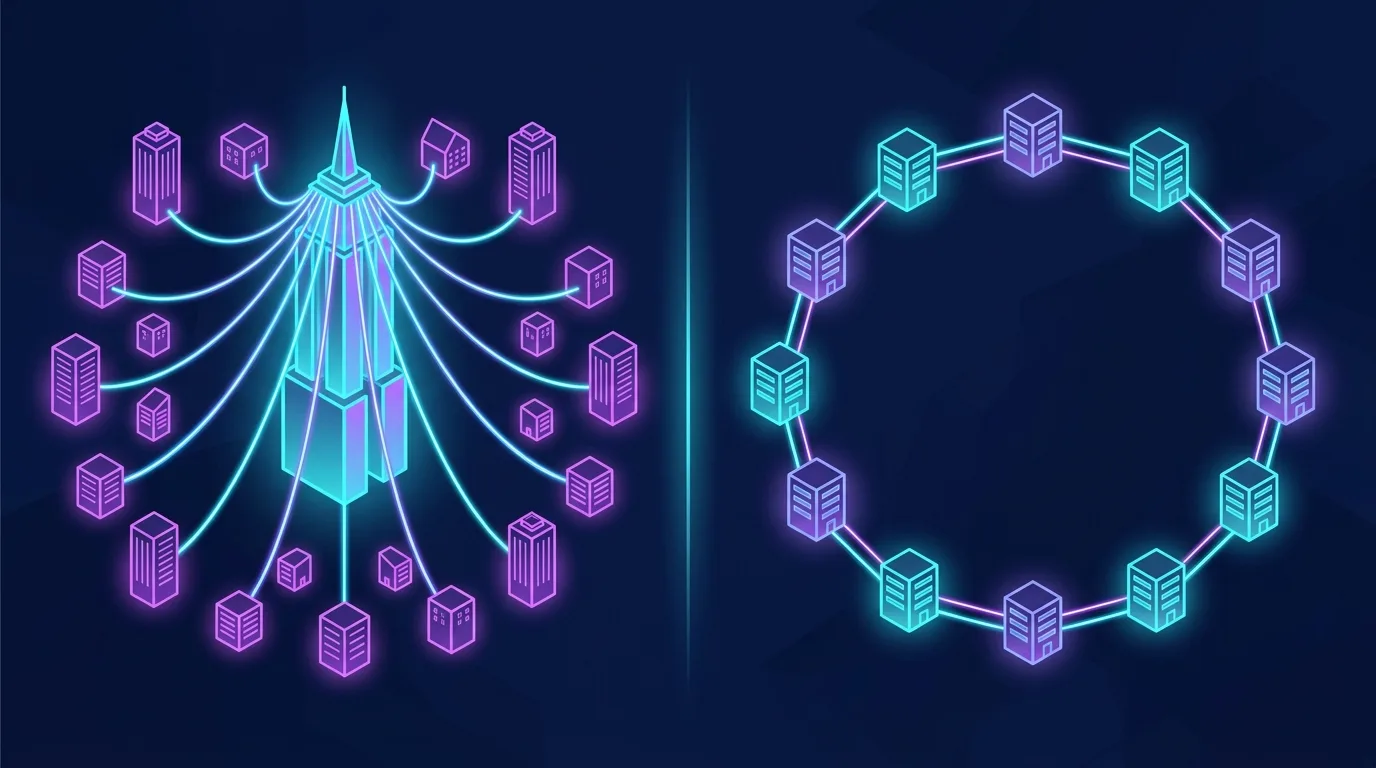
At its simplest, decentralization is the distribution of power, data and decision-making across many participants instead of one central point. A centralized system has a boss; a decentralized one has rules that everyone can check.
Think of a traditional bank. Your balance lives in the bank's database. If the bank's server goes down, your money does not vanish, but your access does. If an administrator makes a mistake, the record changes. You trust the institution to keep things straight.
A blockchain flips that model. The same ledger is copied across thousands of computers called nodes. Each node can verify every transaction. To change history, an attacker would have to convince the majority of the network to agree — which is expensive and, on large networks, practically impossible.
Centralized hub versus decentralized peer-to-peer network.
Three flavors of decentralization
Decentralization is not a single switch. It comes in layers, and a project can be decentralized in one and centralized in another.
| Type | What is distributed | Example |
|---|---|---|
| Architectural | Machines and infrastructure | Thousands of nodes running a blockchain |
| Political | Decision-making power | Token holders voting on protocol upgrades |
| Logical | The data structure itself | One shared ledger, many copies |
A useful test: ask who can unilaterally change the rules? If the answer is "a small team with admin keys", the system is less decentralized than its marketing suggests.
Concrete example
Bitcoin is the classic case. No company owns it, no CEO runs it, and the protocol has survived since 2009 without a central operator. Anyone can download the software and run a node. Compare that with a typical mobile payment app, where a single company decides who can join, what fees apply, and which transactions are blocked.
Why Decentralization Blockchain Matters
Decentralization is not an aesthetic preference. It changes who holds power and who bears risk.
- Censorship resistance. No central party can quietly block a payment or freeze an account. On a public blockchain, a valid transaction is processed regardless of who sends it.
- Transparency. Anyone can audit the ledger. You do not need permission to verify that supply, balances or contract logic match the claims.
- Resilience. There is no single point of failure. If one node goes offline, the network keeps running.
- User ownership. In Web3, users hold their assets in their own wallets rather than in an account controlled by a platform.
That last point is where Web3 fundamentals come in. Web3 is the idea that the next generation of internet services should be built on open, permissionless networks where users own their identity and data, rather than renting access from a platform.
Many nodes hold the same ledger, so no single party controls it.
Concrete example
In 2021, a major cloud provider outage knocked many websites and apps offline for hours. Public blockchains kept producing blocks during the same period because their nodes are spread across many providers and countries. That resilience is not magic — it is the direct result of distributing infrastructure.
The Trade-Offs: Decentralization Is Not Free
Every design choice has a cost. Decentralization usually trades speed, cost and convenience for resilience and neutrality.
| Dimension | Centralized | Decentralized |
|---|---|---|
| Speed | Very fast | Slower (consensus overhead) |
| Cost per transaction | Low | Often higher |
| Censorship resistance | Weak | Strong |
| Single point of failure | Yes | No |
| User experience | Simple | Often complex |
| Governance | Top-down | Community-driven |
This is why most real systems are hybrids. A DeFi app might run on a decentralized blockchain but rely on a centralized front-end website. A stablecoin might be issued by a company while circulating on public networks. Understanding these layers helps you read claims critically.
Concrete example
Ethereum's move from proof-of-work to proof-of-stake in 2022 (the Merge) reduced its energy use dramatically while keeping thousands of validators worldwide. It is a useful case study in how a decentralized network can evolve its own rules through community coordination rather than a corporate decree. To go deeper on how these mechanisms work, see our guide to blockchain consensus mechanisms.
How Decentralization Works, Step by Step
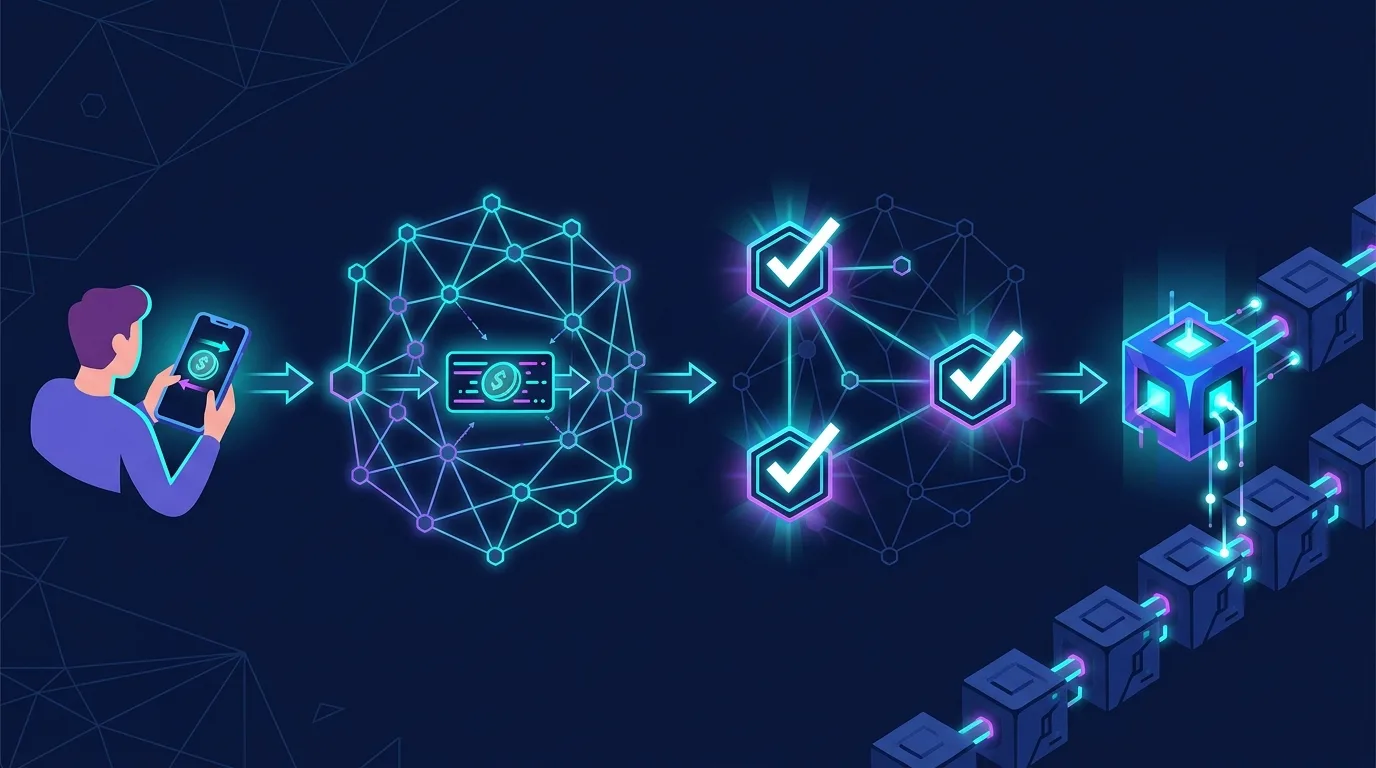
The mechanics are easier to grasp if you follow a single transaction from start to finish.
 From transaction to validated block: the decentralized flow.
Step 1 — A user signs a transaction
A wallet creates a transaction and signs it with a private key. No one needs to ask permission.
// Illustrative only: signing a message with a private key (conceptual)
const message = { to: "0xabc...", amount: 1 };
const signature = wallet.sign(message); // proves the sender authorized it
Step 2 — The transaction spreads across the network
Nodes gossip the transaction to their peers. Within seconds, thousands of machines have a copy.
Step 3 — Nodes validate and reach consensus
Nodes check signatures, balances and rules. Validators or miners then propose a block, and the network agrees on the order of transactions. This is where consensus protocols do their job.
Pseudo-code of a simplified validation loop

receive(transaction):
  if signature_invalid or balance_too_low:
    reject
  else:
    broadcast_to_peers
    add_to_pending_pool
Step 4 — A block is added and the ledger updates
Once consensus is reached, the block is appended. Every node updates its copy. The record is now shared and very hard to reverse.
For a deeper look at the architecture behind this flow, read blockchain architecture: build a strong foundation.
Real-World Use Cases
Decentralization is already doing useful work beyond speculation.
- Payments. Bitcoin enables peer-to-peer transfers without an intermediary. Our Bitcoin explained guide covers the basics.
- DeFi. Lending, trading and stablecoins run on smart contracts, so users keep custody of their funds.
- Digital identity. Decentralized identifiers let users prove attributes without handing over a full profile.
- Supply chains. Shared ledgers let multiple companies verify provenance without trusting one central database.
- Public goods funding. Quadratic funding and on-chain grants let communities allocate resources transparently.
Concrete example
A coffee exporter and a European importer can both write to a shared ledger: harvest date, shipping events, customs clearance. Neither party controls the record alone, so disputes become easier to resolve. That is decentralization doing quiet, practical work.
Risks, Limits and Misconceptions
Decentralization is powerful, but it is not a guarantee of safety or fairness.
- "Decentralized" on paper only. Many projects hold admin keys or upgradeable contracts that let a small team change the rules.
- Governance capture. Token voting can concentrate power in whales or well-organized groups.
- Complexity and user error. Losing a private key means losing funds — there is no support desk.
- Scalability trade-offs. More decentralization often means slower throughput.
- Regulatory uncertainty. Rules vary by country and are still evolving (to verify).
A healthy habit: read the documentation and check who controls upgrades before trusting a "decentralized" label.
How to Get Started
You do not need to be a developer to explore decentralization. Start small and stay curious.
- [ ] Learn the vocabulary: nodes, wallets, consensus, smart contracts.
- [ ] Create a wallet and practice with tiny amounts on a testnet.
- [ ] Run a node if you can — it is the best way to understand the network.
- [ ] Read a smart contract on a block explorer.
- [ ] Follow one protocol's governance forum for a month.
- [ ] Never invest more than you can afford to lose.
Structured learning helps. Our blockchain fundamentals course covers transactions, Merkle trees and consensus in depth, while blockchain for beginners builds a solid mental model from scratch. If you want the plain-English version first, start with blockchain explained without the jargon.
Key Takeaways
Decentralization blockchain is about distributing control so no single party can rewrite the rules or the records. It delivers censorship resistance, transparency and resilience — at the cost of speed, simplicity and sometimes user experience. Real systems sit on a spectrum, so the useful question is always: who can change this, and who can verify it?
FAQ
Is decentralization the same as blockchain?
No. Blockchain is one way to achieve decentralization, but decentralization can exist without a blockchain (for example, peer-to-peer file sharing). A blockchain is a decentralized ledger technology.
Is Bitcoin decentralized?
Largely yes, architecturally and politically: thousands of nodes and miners enforce the rules, with no central operator. Some concentration exists in mining pools, which is a known debate.
Can a decentralized network be hacked?
Individual wallets and smart contracts can be exploited. Attacking the underlying ledger itself requires controlling a majority of the network's consensus power, which is very costly on large chains.
What does "trustless" mean?
It means you do not need to trust a specific intermediary — you can verify the rules and the record yourself. Trust shifts from people to code and cryptography.
Do I need to be technical to use Web3?
No. Wallets and apps are increasingly user-friendly. But basic literacy about keys, networks and risks is essential to stay safe.
- Blockchain Consensus Mechanisms Explained: PoW, PoS and Beyond
- Bitcoin Explained: From Digital Money to Blockchain
- Blockchain vs Bitcoin: Key Differences Explained
- Blockchain Explained: How It Works Without the Jargon
- Blockchain Architecture: Build a Strong Foundation
- Blockchain Fundamentals
- Blockchain for Beginners: How Blockchain Really Works
Comments (0)