
Cryptography Fundamentals: Secrets of Secure Communication

Cryptography fundamentals explained for beginners: how everyday encryption, hashing and digital signatures protect your messages, money and identity — with concrete examples and a practical checklist.
Every time you send a WhatsApp message, pay with a card or log into a website, cryptography is working behind the scenes. Cryptography fundamentals are the set of mathematical techniques that keep digital communication private, authentic and tamper-proof. This guide explains them from scratch, with everyday examples, concrete code and a practical checklist so you can understand — and use — the basics safely.
We will start with what cryptography really is, then look at why it matters, how the main building blocks work, and how to get started without falling into common traps.
Cryptography fundamentals: what they actually are

Cryptography is the practice of transforming readable information (plaintext) into an unreadable form (ciphertext) so that only authorised parties can reverse the process. The word comes from the Greek kryptos (hidden) and graphein (to write). For centuries it was mainly about secrecy in war and diplomacy. Today it is the invisible infrastructure of the internet.
The three goals: confidentiality, integrity, authenticity
A good cryptographic system aims to provide three properties:
- Confidentiality — only the intended recipient can read the message. Example: your browser shows a padlock on
https://sites because TLS encrypts the traffic. - Integrity — the message has not been altered in transit. A single changed bit should be detectable.
- Authenticity — the sender is who they claim to be, and the message really comes from them.
A fourth goal, non-repudiation, means the sender cannot later deny having sent a message. Digital signatures provide it.
Symmetric vs asymmetric encryption
There are two big families of encryption, and beginners often mix them up.
| Property | Symmetric encryption | Asymmetric (public-key) encryption |
|---|---|---|
| Keys | One shared secret key | A public key and a private key |
| Speed | Fast, good for large data | Slower, used for small data or key exchange |
| Key distribution | Must share the secret securely | Public key can be shared openly |
| Typical algorithms | AES, ChaCha20 | RSA, ECC (Elliptic Curve Cryptography) |
| Everyday example | Encrypting a file with a password | TLS handshake, Bitcoin wallets |
Symmetric encryption is like a safe with one key that both people must have. Asymmetric encryption solves the key-sharing problem: you give everyone your open padlock (public key), and only you hold the key that opens it (private key).
Hashing and digital signatures
A hash function takes any input and returns a fixed-size fingerprint. SHA-256 always produces 256 bits (64 hexadecimal characters), and changing one character of the input changes the entire output. Hashes are one-way: you cannot reconstruct the input from the hash.
A digital signature combines hashing and asymmetric keys. You hash the message, then sign the hash with your private key. Anyone can verify the signature with your public key. That is how Bitcoin proves ownership of coins without revealing the private key.
 Symmetric vs asymmetric encryption: shared secret versus public and private keys.
Concrete example
When you visit a bank website, your browser and the server perform a TLS handshake. They agree on a symmetric session key using asymmetric cryptography (often ECDHE), then encrypt the rest of the conversation with a fast symmetric cipher such as AES-GCM. You get the best of both worlds: secure key exchange and fast bulk encryption.
Why cryptography matters: real stakes and everyday impact

Without cryptography, online banking, e-commerce and private messaging would be impossible. Every card payment relies on TLS and on the EMV chip's cryptographic authentication. Every password you store should be hashed with a slow algorithm such as Argon2 or bcrypt, never in plain text.
Money, identity and privacy
Cryptography protects more than messages. It secures:
- Money — card transactions, bank transfers and crypto assets. Bitcoin uses ECDSA signatures on the secp256k1 curve.
- Identity — digital certificates, e-passports and single sign-on.
- Privacy — end-to-end encrypted apps such as Signal, and encrypted storage on your phone.
Weak cryptography has real consequences. The WEP protocol for Wi-Fi was broken because of flawed cryptographic design, and it was replaced by WPA2 and WPA3. The lesson: a system is only as strong as its weakest cryptographic link.
The blockchain connection
Blockchains rely heavily on cryptography fundamentals. Hash functions link blocks together (each block contains the hash of the previous one), Merkle trees summarise transactions efficiently, and public-key signatures authorise transfers. To see how these pieces fit into a distributed system, read our guide on blockchain architecture and the course on blockchain fundamentals.
From messaging to banking, cryptography secures the digital services we use daily.
Concrete example
In Bitcoin, a transaction is signed with the sender's private key. Miners and nodes verify the signature against the public key derived from the sender's address. If a single bit of the transaction changes, the signature becomes invalid and the transaction is rejected. No central authority is needed to check identity — the math does it.
How it works, step by step
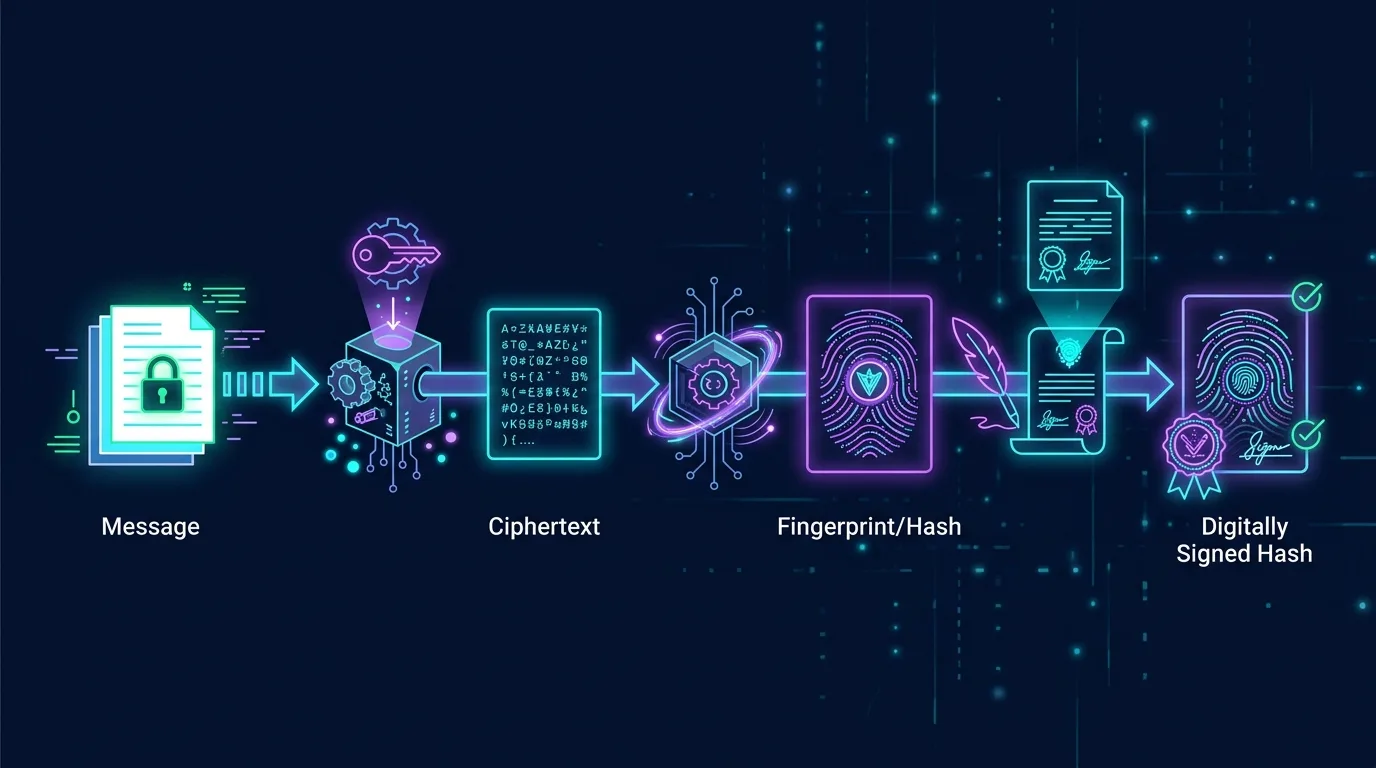
Here is a simplified workflow you can follow to understand any secure communication system.
Step 1 — Agree on keys
Two parties need compatible keys. In symmetric systems they share a secret. In asymmetric systems each party generates a key pair. Modern protocols often combine both: a temporary asymmetric exchange creates a symmetric session key.
Step 2 — Encrypt the message
The plaintext is transformed into ciphertext using the agreed key and algorithm. A minimal illustration in Python with the cryptography library:
# Illustrative only: symmetric encryption with AES-GCM
from cryptography.hazmat.primitives.ciphers.aead import AESGCM
import os

key = AESGCM.generate_key(bit_length=256)
aesgcm = AESGCM(key)
nonce = os.urandom(12)
ciphertext = aesgcm.encrypt(nonce, b"hello world", None)
print(ciphertext.hex())
Step 3 — Hash and sign
For integrity and authenticity, hash the message and sign the hash. A short JavaScript example using the Web Crypto API:
// Illustrative only: SHA-256 hash in the browser
async function sha256(message) {
  const data = new TextEncoder().encode(message);
  const digest = await crypto.subtle.digest('SHA-256', data);
  return Array.from(new Uint8Array(digest)).map(b => b.toString(16).padStart(2, '0')).join('');
}
sha256('hello').then(console.log);
Step 4 — Verify on the other side
The recipient decrypts, recomputes the hash and checks the signature. If any step fails, the message is rejected. This is exactly what your browser does with a TLS certificate.
The core workflow: encrypt, hash, sign and verify.
Concrete example
When you download a software update, the vendor often publishes a SHA-256 checksum. You compute the hash of the downloaded file and compare it with the published value. A mismatch means the file was corrupted or tampered with. It is a simple, free integrity check anyone can do.
Real-world use cases
Cryptography fundamentals appear in more places than most people realise. Here are four concrete ones.
Secure messaging
Signal and WhatsApp use the Signal Protocol, which combines the Double Ratchet algorithm with X25519 key exchange and AES-256 or ChaCha20 encryption. Messages are end-to-end encrypted, so even the service provider cannot read them.
Cryptocurrency wallets
A wallet is essentially a key pair. The private key signs transactions; the public key derives the address. Lose the private key and you lose the funds — no customer support can recover them. For a broader view of how wallets and transactions work, see cryptocurrency fundamentals.
Digital certificates and HTTPS
Certificate authorities sign public keys with their own private keys. Your browser trusts a list of authorities and verifies the signature on every HTTPS connection. That padlock icon is applied cryptography in action.
Password storage
Websites should never store passwords in plain text. They store a salted hash produced by a slow algorithm such as Argon2id, bcrypt or scrypt. When you log in, the site hashes your input and compares it with the stored hash.
Risks, limits and misconceptions
Cryptography is powerful, but it is not magic. Most real-world failures come from misuse, not from broken math.
Common misconceptions
- "Encryption hides everything." It hides content, not metadata such as who talked to whom and when.
- "Hashing is encryption." Hashing is one-way; encryption is reversible with the key.
- "A longer key is always better." Key length matters, but so do algorithm choice, implementation and key management.
- "Quantum computers break everything tomorrow." Large-scale quantum threats are a research and planning concern; post-quantum algorithms are being standardised, but migration takes years (to verify).
Real limits
- Key management is the hardest part. A strong cipher with a leaked key is useless.
- Implementation bugs are common. Heartbleed (2014) was a memory bug in OpenSSL, not a flaw in TLS itself.
- Human factors matter. Phishing often bypasses cryptography entirely by stealing credentials.
How to get started
You do not need a maths degree to use cryptography well. Start with safe defaults and good habits.
Practical checklist
- [ ] Use HTTPS everywhere and check the padlock on sensitive sites.
- [ ] Enable end-to-end encrypted messaging for private conversations.
- [ ] Store passwords in a reputable password manager, not in a spreadsheet.
- [ ] Turn on two-factor authentication, preferably with an app or hardware key.
- [ ] Back up crypto wallet private keys offline and never share them.
- [ ] Verify software checksums when available.
- [ ] Keep devices and apps updated to receive cryptographic fixes.
Learn the foundations
If you want to go deeper, our course Understanding Cryptography builds intuition for hashing, keys and signatures with interactive labs. Pair it with Bitcoin explained to see how these primitives secure a real monetary network.
Conclusion: cryptography is a life skill
Cryptography fundamentals boil down to a few ideas: protect confidentiality with encryption, guarantee integrity with hashing, prove authenticity with signatures, and manage keys carefully. Once you grasp these building blocks, the digital world becomes less mysterious — and you make better security decisions every day. Start with the checklist, keep learning, and treat your keys like the keys to your home.
FAQ
What is the difference between encryption and hashing?
Encryption is reversible with the right key; hashing is a one-way transformation that produces a fixed-size fingerprint. You encrypt data you need to read later, and hash data you only need to verify.
Is cryptography only for experts and developers?
No. Everyone uses it daily through HTTPS, messaging apps and banking. Understanding the basics helps you avoid scams and configure your accounts more safely.
Can cryptography be broken?
Well-designed algorithms such as AES-256 and SHA-256 are considered strong against classical attacks. Weaknesses usually appear in implementation, key management or outdated protocols, not in the core math.
What is a digital signature used for?
It proves that a message or transaction was created by the holder of a specific private key and has not been altered. It is used in TLS, software updates, email and blockchain transactions.
Do I need to understand the maths to use crypto safely?
No. You need good habits: strong unique passwords, two-factor authentication, verified software and safe key storage. The maths is handled by the tools you use.
- Cryptocurrency Fundamentals: How Digital Assets Really Work
- Decentralization Blockchain: The Core Idea Behind Web3
- Blockchain Architecture: Build a Strong Foundation
- Bitcoin Explained: From Digital Money to Blockchain
- Blockchain Nodes: How the Network Stays Decentralized
- Blockchain for Beginners: How Blockchain Really Works
- Blockchain Fundamentals
- Understanding Cryptography
Comments (0)