
How Crypto Wallets Work: Keys, Seeds & Security
Crypto wallets don't store coins — they hold the keys that prove ownership. Learn how private keys, seed phrases and transactions work, and how to keep your funds safe in 2026.
A crypto wallet does not store your coins. It stores the keys that prove you own them, and everything else — balances, history, transfers — lives on the blockchain. That single idea explains most of what follows, and it is also where beginners get hurt: lose the keys, lose the funds, with no customer support to call. This guide walks through what Crypto wallets actually are, why crypto security matters more than ever in 2026, how keys and transactions work step by step, and the practical habits that keep self-custody safe. If you want the wider picture first, our guide to cryptocurrency fundamentals covers blockchain, assets and exchanges before you dive into wallets.
What Is a Crypto Wallet, Really?
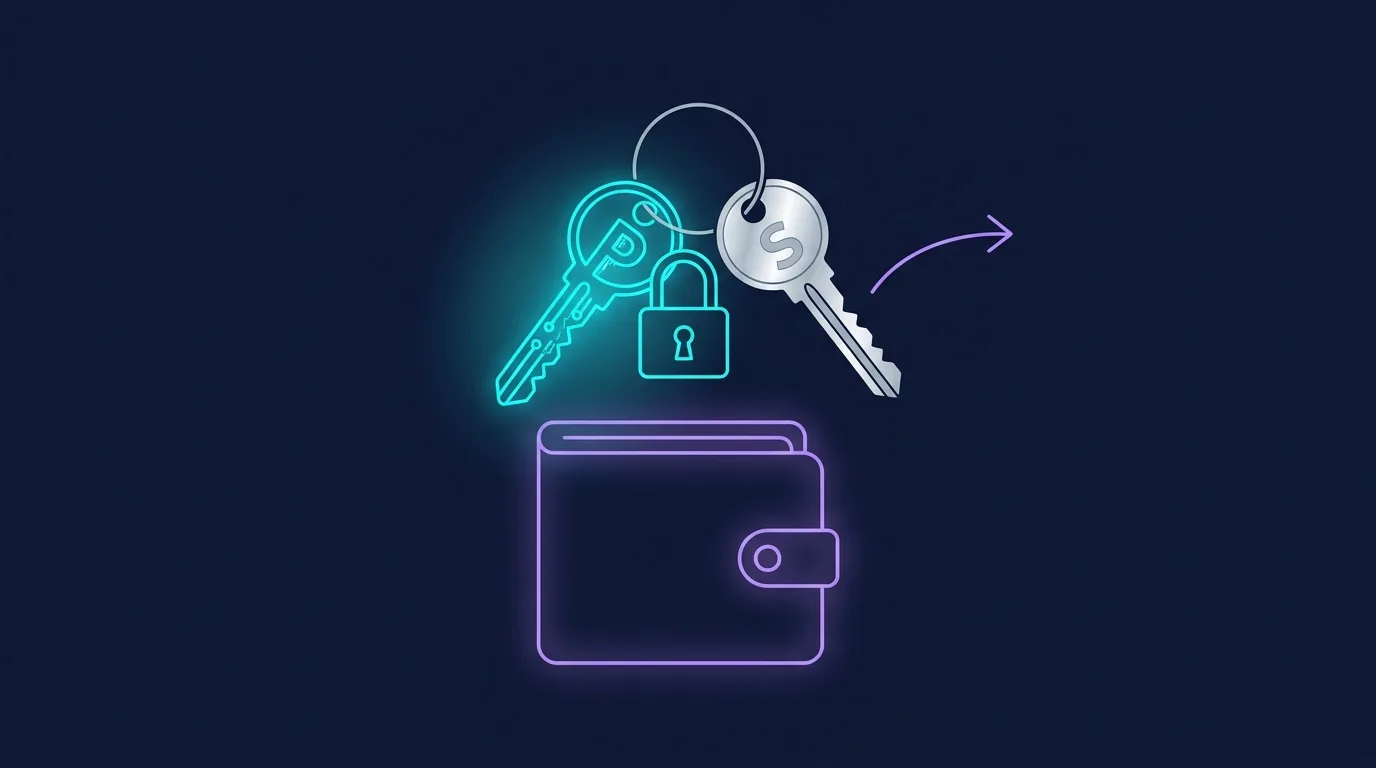
A crypto wallet is software or hardware that manages your keys and lets you sign transactions. The wallet itself holds no money. It holds a private key, derives a public address from it, and uses that key to authorise transfers.
The key pair: private key and public address
A private key is a very large random number. From it, cryptography derives a public key, and from the public key you get an address you can share. The relationship is one-way: anyone can go from private key to address, nobody can go backwards.
In practice, for Ethereum-style accounts the private key ( k ) is a 256-bit number, and the address is derived through elliptic-curve multiplication and hashing:
[ A = \text{last20bytes}\big(\text{Keccak-256}(\text{pubkey})\big) ]
The security rests on the discrete-logarithm problem: given ( A ), recovering ( k ) is computationally infeasible. If you want the mechanics in depth, the cryptography fundamentals course builds intuition for hashing, keys and signatures from first principles.
 The public key can be shared; the private key must never leave your control.
Seed phrases: one backup for many keys
Typing a raw private key is error-prone. Modern wallets use a seed phrase (also called a recovery phrase): 12 or 24 common words generated from a standard called BIP-39. From that phrase, the wallet deterministically derives every key and address you will ever use.
BIP-39 flow (simplified)
entropy (128 or 256 bits) -> checksum -> 12 or 24 words
seed = PBKDF2(mnemonic, "mnemonic" + passphrase)
for each account index i:
    private_key_i = derive(seed, path "m/44'/60'/0'/0/i")
That is why the phrase is the real wallet. Import the same words into another app and you recover the same accounts. The app is disposable; the phrase is not.
Concrete example
Alice installs a mobile wallet, writes down 12 words, and receives address 0x…a1b2. She later drops her phone in a lake. On a new phone, she installs a different wallet brand, enters the same 12 words, and her accounts and balances reappear instantly. Nothing was stored on the phone — only the phrase mattered.
Why Crypto Security Matters More Than Ever
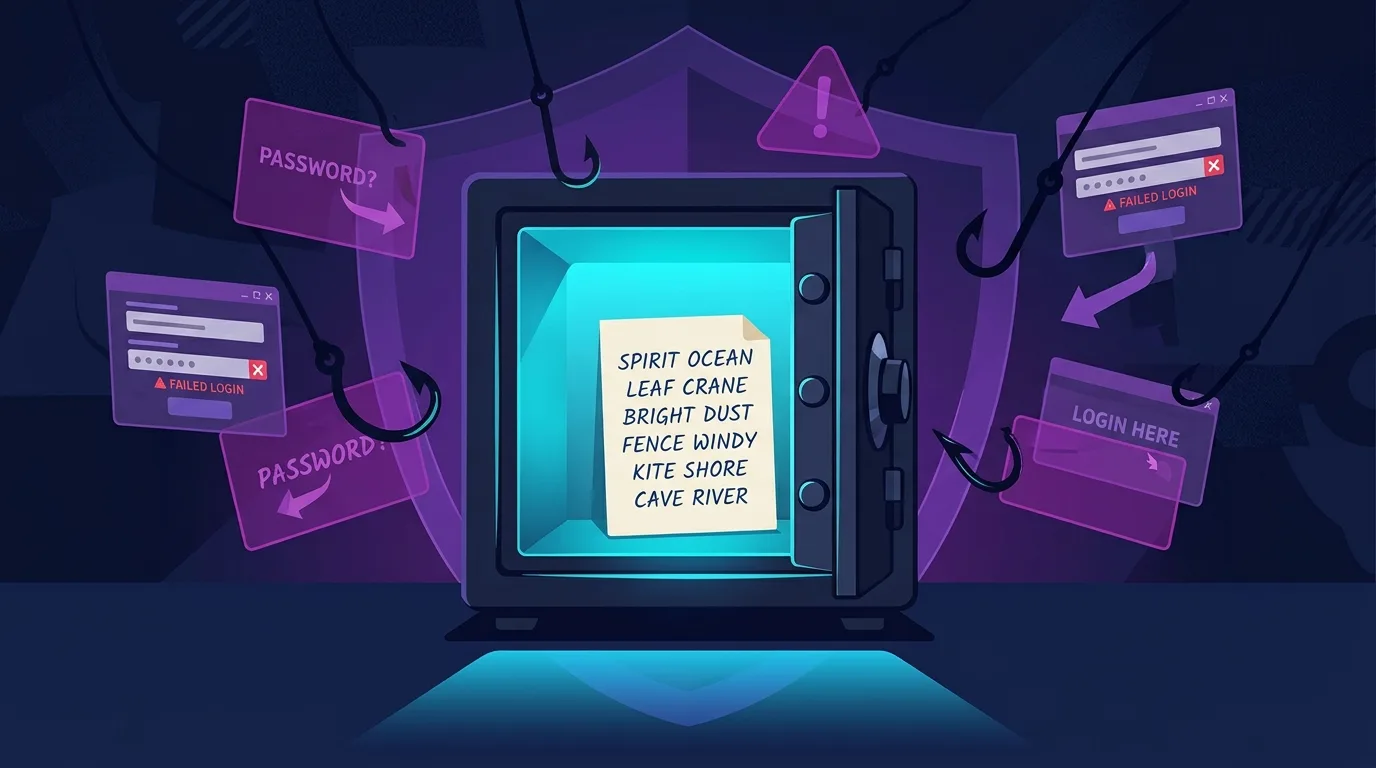
The blockchain's cryptography is robust. Human handling of keys is not. Most losses come from stolen seed phrases, malicious approvals, fake apps and simple mistakes — not from broken encryption.
Concrete example
A common 2022–2023 pattern: a user signs an unlimited token approval on a dubious site, and months later a contract drains the wallet. The signature was valid; the user simply did not understand what they authorised. On-chain, there is no chargeback.
Self-custody versus custodial wallets
| Criterion | Self-custody wallet | Custodial (exchange) wallet |
|---|---|---|
| Who holds the keys | You | The provider |
| Recovery if you lose access | Seed phrase | Provider support |
| Counterparty risk | None (but full responsibility) | Provider insolvency, freezes |
| Best for | Long-term holdings, larger amounts | Small trading balances |
The trade-off is simple: self-custody removes counterparty risk and adds personal responsibility. For a deeper look at how the underlying chain protects data, see how blockchain security actually protects your data.
Most losses come from stolen seed phrases, not broken cryptography.
How a Transaction Works, Step by Step
Step 1 — Build the transaction
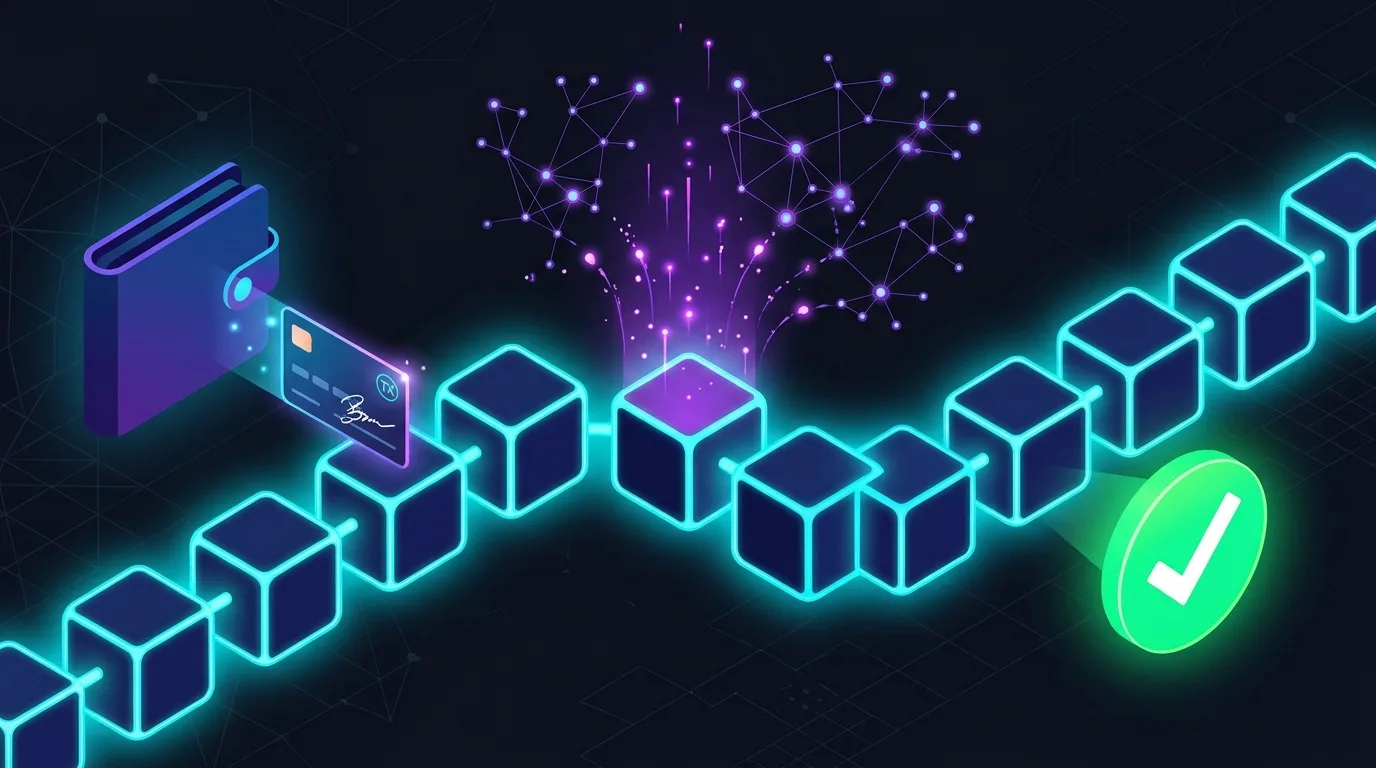
Your wallet assembles the transfer: recipient address, amount, network fee, and a nonce (a counter that prevents replay). It then signs the payload with your private key.
// Illustrative only — do not use with real funds
import { Wallet } from "ethers";

const wallet = new Wallet(process.env.PRIVATE_KEY); // never hardcode in production
const tx = {
  to: "0xRecipientAddressHere",
  value: 1_000_000_000_000_000n, // 0.001 ETH in wei
  gasLimit: 21000n,
  maxFeePerGas: 30_000_000_000n,
  maxPriorityFeePerGas: 1_500_000_000n,
  nonce: 7,
  chainId: 1,
};

const signed = await wallet.signTransaction(tx);
console.log(signed); // broadcast this hex payload
Step 2 — Broadcast to the network
The signed transaction is sent to nodes that validate the signature and check the balance. If anything is wrong, it is rejected before it ever reaches a block.
Step 3 — Confirmation
Miners or validators include the transaction in a block. On Ethereum, a confirmation is probabilistic; on Bitcoin, the common heuristic is to wait for several blocks. Our walkthrough of blockchain transactions from wallet to confirmation details this journey.
Concrete example
Bob sends 0.01 ETH with a fee of 0.0003 ETH. His wallet shows the total debit, not just the amount. If he had set the fee too low during congestion, the transaction could sit pending for hours — or be dropped by the mempool.
Sign, broadcast, confirm: the three steps every on-chain transfer follows.
Risks, Limits and Misconceptions
- "The wallet holds my coins." No — the blockchain holds balances; the wallet holds keys.
- "Seed phrases can be reset." They cannot. If lost, funds are unrecoverable.
- "Hardware wallets are unhackable." They reduce attack surface, but a careless signature can still drain funds.
- "Small test transfers are optional." Always send a small amount first when using a new address.
How to Get Started Safely
- [ ] Choose a reputable wallet; verify the download source.
- [ ] Write the seed phrase on paper or metal — never a photo or cloud note.
- [ ] Test recovery with a tiny amount before moving real funds.
- [ ] Use a hardware wallet for significant holdings.
- [ ] Review token approvals periodically and revoke unused ones.
- [ ] Keep a small "hot" balance for daily use, the rest in cold storage.
Conclusion
Crypto wallets are key managers, not piggy banks. Understand the private key, protect the seed phrase, and treat every signature as a legal act — that is the whole of crypto security in three sentences. For the foundations underneath, the Blockchain for Beginners course is a good next step.
FAQ
Can I recover funds if I lose my seed phrase?
No. Without the seed phrase or private key, no one — including the wallet maker — can reconstruct access.
Is a seed phrase the same as a private key?
No. A seed phrase generates many private keys deterministically; it is the master backup.
Are custodial wallets safer for beginners?
They are simpler, but you rely on the provider. For larger amounts, self-custody with a hardware wallet is generally safer.
Can a transaction be reversed?
Once confirmed on-chain, generally no. Chargebacks do not exist in most public blockchains.
How much should I keep in a hot wallet?
Only what you need for near-term use. Treat the rest as long-term savings in cold storage.
- Cryptocurrency Fundamentals: How Digital Assets Really Work
- Cryptocurrency development: build a coin from scratch
- How Blockchain Security Actually Protects Your Data
- Blockchain Transactions Explained: From Wallet to Confirmation
- Cryptography Fundamentals: Secrets of Secure Communication
- Blockchain for Beginners: How Blockchain Really Works
- Understanding Cryptography
- Blockchain Fundamentals
Comments (0)